Most people read a certificate of analysis the way they read a receipt: they look for the number at the bottom and move on. The number at the bottom is usually a purity figure, and on its own it is close to meaningless. A certificate is a structured set of claims, each answering a different question, and the value of the document lies in whether those questions were asked by someone with no stake in the answer.
The header is the part people skip
Before any result, a credible certificate identifies four things: what was tested, which batch it came from, who tested it, and when. A missing batch identifier is disqualifying. Without it the document describes an unnamed sample and cannot be tied to the vial in front of you — which is the entire purpose of the exercise.
- Sample identity — the compound name as submitted, not as marketed.
- Batch or lot number — must match the vial label exactly.
- Testing laboratory — named, with an accession or report number that the laboratory itself can retrieve.
- Date of analysis — a certificate describes a moment, not a permanent state.
Purity and identity are different claims
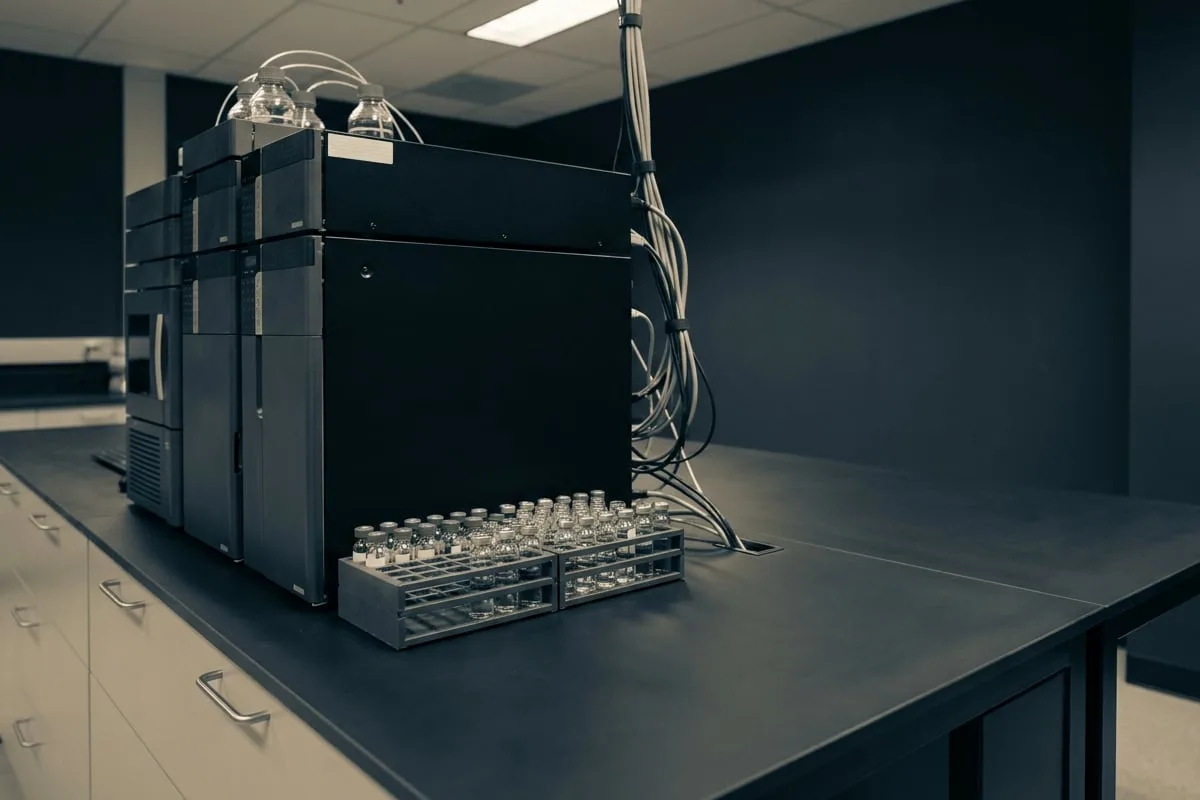
Purity asks how much of the sample is the principal component. Identity asks whether that principal component is the compound named on the label. High-performance liquid chromatography answers the first; mass spectrometry answers the second. A certificate reporting 99.4% purity with no mass confirmation has told you that the sample is homogeneous. It has not told you what it is homogeneous with.
Content is not the same as strength
The label says 5 mg. The certificate reports assayed content, which is what the laboratory actually found. Those two figures are rarely identical, and the gap matters more in some work than others. Where a compound acts catalytically, a small variance is tolerable. Where it is consumed stoichiometrically — as a cofactor is — the assayed figure is the one to build the calculation on.
What a good certificate includes beyond purity
- Residual solvent analysis — what remains from synthesis and purification.
- Water content by Karl Fischer titration — directly affects the accuracy of any mass-based calculation.
- Endotoxin or bioburden result where the material's intended handling warrants it.
- Appearance and solubility observations — the cheapest test in the set, and the one that catches gross problems first.
Independence is the whole argument
A manufacturer testing its own material is not producing verification; it is producing a claim about a claim. The question a certificate exists to settle is whether someone with nothing to gain looked at the sample and wrote down what they found. If the certificate does not name a laboratory you can contact independently, it has not settled that question.