There is a persistent confusion in how analytical results are quoted, and it survives because both figures are expressed in the same confident language. Purity and identity sound like two ways of saying the same thing. They are not. They are answers to questions that do not overlap, produced by instruments that measure entirely different properties.
What purity actually measures
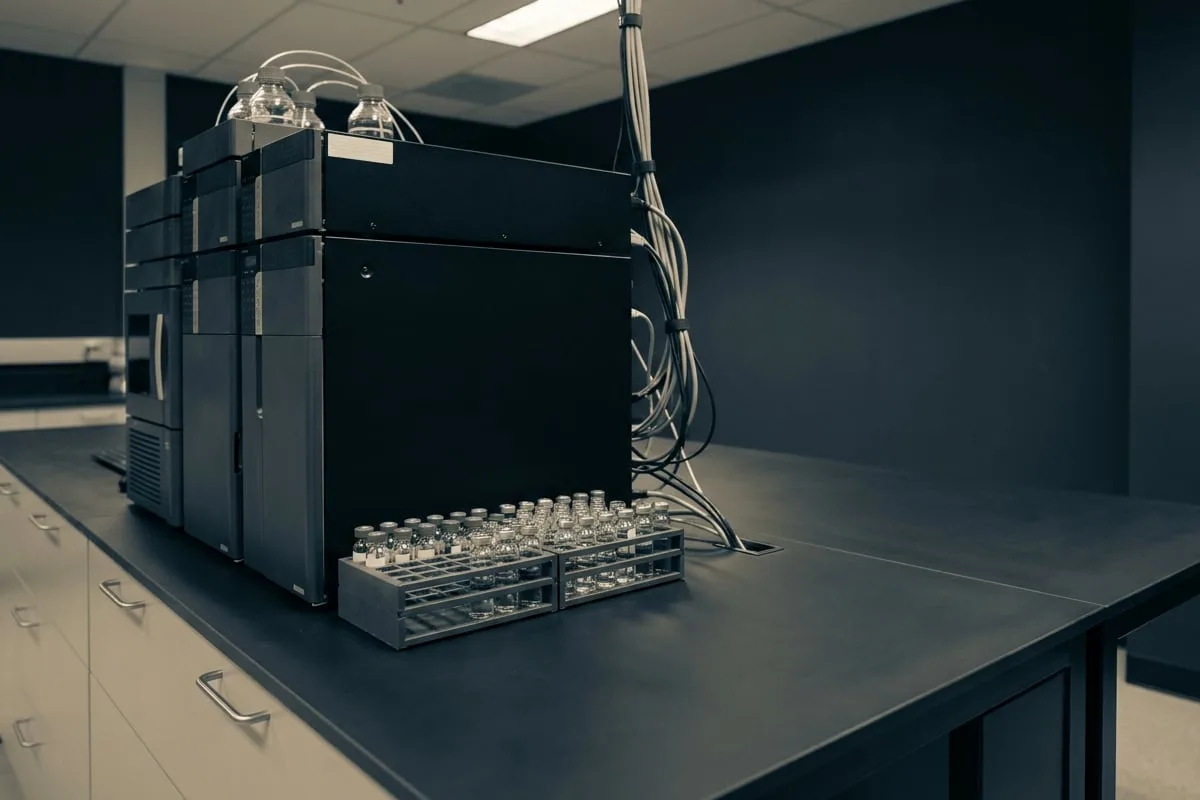
In reversed-phase HPLC, a sample is carried through a column that separates components by their affinity for the stationary phase. What emerges is a chromatogram: a trace with peaks, each corresponding to something that came off the column at a particular time. Purity is the area of the principal peak expressed as a percentage of total peak area. It is a statement about homogeneity — that the sample is overwhelmingly one substance.
A chromatogram tells you the sample is one thing. It does not tell you which thing.
Where that leaves a deletion sequence
Solid-phase peptide synthesis builds a chain one residue at a time, and coupling is never perfectly efficient. A chain that failed to accept a residue continues to be extended and emerges as a deletion sequence: a peptide one amino acid short of the target. Depending on which residue is missing, it may have almost identical retention behaviour. It can co-elute. It can present as a clean single peak.
What mass spectrometry adds
Mass spectrometry ionises the sample and measures mass-to-charge ratio. A peptide missing one glycine residue is 57 daltons lighter than the intended sequence — invisible to a retention-time measurement, unmistakable on a mass spectrum. This is why identity confirmation is not an optional supplement to purity testing. It is the half of the question that purity cannot reach.
The practical test
When you next read a certificate, find the purity figure — then look for the mass. If the document reports one without the other, it has answered half a question and presented it as a whole one.