Longevity / Coenzyme
NAD+
An endogenous pyridine dinucleotide coenzyme central to cellular redox biochemistry.
- Research domain
- Longevity
- Presentation
- 500 mg / vial
- Assayed purity
- 99.17%
- Evidence base
- Extensively studied
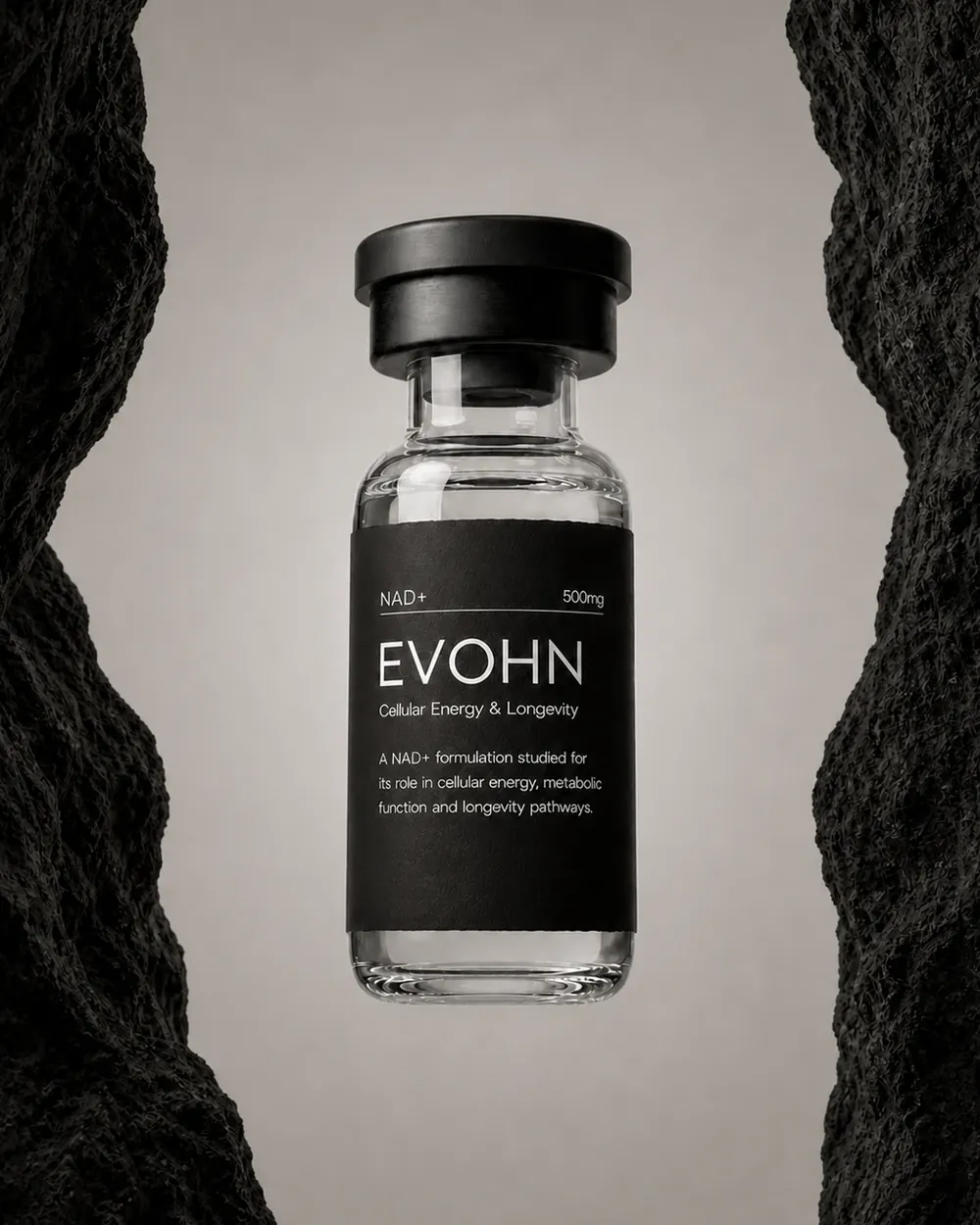
Also designatedNicotinamide adenine dinucleotide · Coenzyme I · NAD · NAD plus
Quick facts
- Purity specification
- ≥ 99% by HPLC
- Physical form
- Lyophilised powder
- Presentation
- 500 mg / vial
- Evidence base
- Extensively studied
- Intended use
- Laboratory research only
Current batch · EVN-NAD-2606
Meridian Analytical Laboratories, 12 Jun 2026. Assayed content 512.4 mg / 500 mg.
View certificateResearch overview
How it is characterised
Nicotinamide adenine dinucleotide is an endogenous coenzyme present in every living cell, cycling between oxidised and reduced states as an electron carrier. Literature examines its function as a required cofactor for sirtuin deacetylases, poly-ADP-ribose polymerases and CD38 hydrolase, and the relationship between cellular concentration and mitochondrial oxidative capacity.
Mechanism
Functions as an obligate electron acceptor in catabolic oxidation and as the substrate consumed by NAD-dependent enzymes. Published work examines how the balance between synthesis via the salvage pathway and consumption by PARPs, sirtuins and CD38 determines the free pool available for oxidative phosphorylation.
Applications
- Cellular ageing research
- Redox biochemistry assays
- Mitochondrial function characterisation
- Enzyme cofactor studies
Research focus
Areas of published investigation
The following describe where this compound has been examined in the scientific literature. They are not claims of effect, and nothing here should be read as a therapeutic indication.
- 01Sirtuin-dependent deacetylation
- 02PARP-mediated DNA repair signalling
- 03Mitochondrial oxidative phosphorylation
- 04Cellular redox state characterisation
Research compatibility
Frequently co-studied
Compounds that appear alongside NAD+ in the published record, and the reason the literature examines them together.
Molecular & pharmacokinetic data
The physical record
Verify every figure against the certificate of analysis for the batch you hold. Where the label and the assay disagree, the assay is the number to calculate from.
- CAS number
- 53-84-9
- Molecular formula
- C₂₁H₂₇N₇O₁₄P₂
- Molar mass
- ≈ 663.43 g/mol
- Reported half-life
- Rapid turnover; pool-dependent
- Solubility
- Freely soluble in water; pH-sensitive in solution
Analytical record
Batch EVN-NAD-2606
Analysed by Meridian Analytical Laboratories, ISO/IEC 17025 accredited, under accession MAL-26-06210. The certificate is retrievable from the issuing laboratory independently of us.
Full certificate- Purity
- 99.17%RP-HPLC, UV 214 nm · spec ≥ 99.0%
- Identity
- 663.5 Da (theoretical 663.4)ESI-MS · spec Conforms to theoretical mass
- Assayed content
- 102.5% of labelRP-HPLC against reference standard · spec 95.0 – 110.0% of label
- Water content
- 5.7%Karl Fischer titration · spec ≤ 8.0%
- Residual solvents
- Ethanol 204 ppm; methanol below quantitationHeadspace GC-FID · spec Within USP <467> limits
- Appearance
- White to pale cream lyophilised powderVisual inspection · spec Conforms
Storage
Store lyophilised at −20 °C, protected from light and moisture. NAD+ is hygroscopic and light-sensitive; minimise exposure during handling. Following reconstitution, hold at 2–8 °C and use within the interval stated on the batch certificate of analysis.
Handling
Hygroscopic. Keep the vial closed until the moment of reconstitution and return unused material to cold storage promptly. Prepare in subdued light and avoid prolonged exposure at ambient temperature, which accelerates degradation of the oxidised form.
Packaging
Amber borosilicate vial with butyl stopper and aluminium crimp seal, presented in a matte debossed box with die-cut foam insert and magnetic closure.
Selected references
The published record
A starting point rather than a survey. Entries are listed for orientation and do not constitute endorsement of any interpretation drawn from them.
- 01NAD+ metabolism and its roles in cellular processesNature Reviews Molecular Cell Biology, 2021
- 02Sirtuins, NAD+ and the mitochondrial unfolded protein responseCell, 2013
- 03NAD+ salvage pathway flux and cellular concentrationJournal of Biological Chemistry, 2019
This catalogue is presented for informational purposes only. It is not an offer of sale, and it makes no medical or therapeutic claim.
You may also be studying
Enquiries
Request the batch documentation.
Ask a specialist about NAD+ — its current batch, analytical documentation, and what can be supplied to your territory.